Stem Cell Therapy 2026: Can We Actually Regenerate a Damaged Heart Muscle?
For decades, the medical world operated under a grim biological “truth”: once the human heart is damaged by a heart attack, the tissue is gone forever, replaced only by a stiff, lifeless scar. But as we stand in 2026, a revolutionary question is being answered in labs and clinics across the globe: What if we could use your own biological code to reboot your heart’s hardware and grow back the muscle you lost?
The human heart is an incredible machine, beating over 100,000 times a day without a single break. However, it has one major design flaw: unlike your skin, which heals from a cut, or your liver, which can regrow a lost section, the heart has very little regenerative capacity. When a coronary artery is blocked—the classic “heart attack”—the oxygen-starved muscle cells (cardiomyocytes) die. The body, in a desperate attempt to maintain structural integrity, fills the gap with fibrous scar tissue. While this scar prevents the heart from rupturing, it doesn’t pump. It is dead weight.
As we move through 2026, the field of Regenerative Medicine is shifting this narrative. The promise of Stem Cell Therapy is no longer a “someday” science fiction concept; it is a burgeoning clinical reality that seeks to turn the “scar” back into “strength.”
The Biological Dogma: Why the Heart Doesn’t Heal Itself
To understand why stem cell therapy is such a breakthrough, we must first understand the problem of fibrosis. In most mammals, the heart’s ability to regenerate its cells effectively shuts down shortly after birth. When damage occurs in adulthood, the inflammatory response triggers “fibroblasts” to create a collagen-heavy scar.
This scar tissue is stiff. It impairs the heart’s ability to relax and contract (diastolic and systolic function). Over time, this leads to heart failure—a state where the heart simply cannot keep up with the body’s demand for blood. Until recently, the only “fix” for end-stage heart failure was a transplant, a solution limited by the scarcity of donors and the risks of rejection.
Enter the Stem Cell: The 2026 Landscape of Cardiac Repair
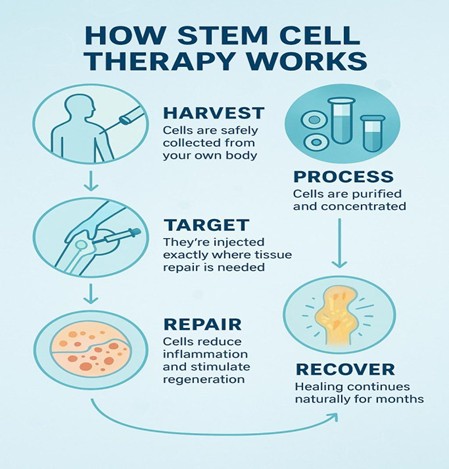
Stem cells are the body’s “master cells.” They have the unique ability to transform into specialized cell types. In the context of cardiac care in 2026, researchers are focusing on several key types of cells and delivery mechanisms to achieve regeneration.
- Mesenchymal Stem Cells (MSCs)
Derived from bone marrow or umbilical cord tissue, MSCs have been a primary focus of clinical trials. Interestingly, research suggests these cells don’t just “become” new heart cells. Instead, they act like a high-tech “construction foreman.” They release a cocktail of growth factors and anti-inflammatory signals (known as paracrine factors) that tell the heart’s existing cells to stop dying and start repairing.
- Induced Pluripotent Stem Cells (iPSCs)
This is the “Nobel Prize” tier of biohacking. In 2026, we are seeing more refined methods of taking a patient’s own skin or blood cells and “reprogramming” them back into a stem cell state. These cells can then be directed to become actual, beating cardiomyocytes. This “autologous” approach (using the patient’s own cells) effectively eliminates the risk of immune rejection.
- The Exosome Revolution: Cell-Free Therapy
One of the biggest shifts in 2026 is moving away from injecting whole cells and toward Exosomes. These are tiny “nanovesicles” secreted by stem cells. Think of them as the biological “text messages” containing the instructions for repair. By injecting only the exosomes, we can achieve the regenerative benefits of stem cells without the risks associated with injecting live cells into the heart’s sensitive electrical environment.
The Delivery: How Do We Get the Cells into the Heart?
Regenerating a heart isn’t as simple as taking a pill. In 2026, the delivery methods have become highly sophisticated, often performed in the same high-tech catheterization labs where we perform angiography or TAVI
- Intracoronary Injection: The cells are delivered through a catheter directly into the coronary arteries, allowing them to flow into the damaged area.
- Intramyocardial Injection: Using 3D mapping technology, a cardiologist can inject cells directly into the “border zone”—the area between the dead scar and the healthy muscle—where regeneration is most likely to take hold.
- Engineered Cardiac Patches: In more severe cases, bio-engineered “scaffolds” seeded with stem cells can be surgically applied to the surface of the heart to provide a framework for new tissue growth.
Myth vs. Reality: Is it a “Cure”?
It is important to maintain a direct and candid perspective on the current state of therapy. While the term “regeneration” sounds like a magic wand, the 2026 reality is one of incremental improvement.
We are not yet at the stage where a completely dead heart can be made 100% new. However, we are seeing clinical successes where a patient’s “Ejection Fraction” (the measure of how much blood the heart pumps out with each beat) increases by 5% to 10%. In the world of heart failure, that small percentage can be the difference between being bed-bound and being able to walk in the park with your grandchildren.
Furthermore, the consensus among authoritative heart centers is that stem cell therapy is not a standalone solution. It must be part of a comprehensive strategy that includes advanced diagnostics, such as a stress test to measure functional capacity, and traditional interventions to ensure the “new” muscle has a sufficient blood supply.
The Role of Authoritative Guidance in 2026
With any “frontier” technology, there is always a risk of misinformation. You may see advertisements for “stem cell clinics” promising to cure every ailment under the sun. It is vital to separate clinical cardiac regeneration from unregulated “wellness” injections.
Real cardiac regeneration requires a deep understanding of the heart’s electrical and structural landscape. This is where the expertise of a specialized heart care center becomes indispensable. For patients in the Navi Mumbai and Pune regions, navigating these advanced options requires a partnership with a cardiologist who understands both the traditional gold standards and the emerging future of medicine.
At Cardium, led by Dr. Rahul Gupta, the philosophy is built on data-driven, patient-first care. Whether we are discussing the long-term durability of a transcatheter valve or the potential of regenerative therapies, the goal is always the same: providing the most authoritative, evidence-based care available.
Conclusion: The Roadmap to a Regenerated Future
Can we actually regenerate a damaged heart muscle in 2026? The answer is a hopeful, scientific yes, but with conditions. We have successfully moved from “can we do it?” to “how can we do it better?”
The future of heart care is no longer just about preventing death; it is about restoring the quality of life. By combining the best of today’s technology—like precision stenting and AI-guided imaging—with the regenerative potential of stem cell biology, we are giving patients a reason to look forward to the next decade with confidence.
Your heart has taken care of you for a lifetime. In 2026, we finally have the tools to return the favor. To learn more about advanced cardiac screenings and the future of heart care, visit Cardium Heart Care.
Contact Information (NAP)
Dr. Rahul Gupta Cardium Heart Care
Address: Shop No. 1 & 2, Intercity CHS, Swami Samarth Marg, behind Fire Brigade, Juhu Nagar, Sector-16, Vashi, Navi Mumbai, Maharashtra 400703
Phone no: 09869325666
Recent Posts
-
 Stem Cell Therapy 2026: Can We Actually Regenerate a Damaged Heart Muscle?
 -
 Pacemakers in 2026: Why the Latest Leadless Devices are Practically Invisible Under the Skin
 -
 The 10-Minute TMT: What Your Stress Test Result Actually Says About Your 10-Year Heart Risk
 -
 How Advanced Heart Care is Giving Pune’s Grandparents a Second Lease on Life
 -
 Stent vs. Bypass: How AI-Guided Imaging Helps Dr. Rahul Gupta Make the “Perfect” Choice for You