The “Wrist-First” Advantage: Why Radial Angiography Means You Can Walk Out the Same Day
The word “angiography” often carries a heavy weight. For many, it conjures images of intensive hospital stays, hours of lying perfectly still in a cold bed, and a long, uncomfortable recovery. Historically, this was the reality. When heart procedures were primarily performed through the femoral artery in the groin, patients faced significant bed-rest requirements and a higher risk of bleeding.
But the world of interventional cardiology has shifted.
Today, a revolutionary approach—Transradial Angiography—has turned a daunting hospital experience into a streamlined, “walk-in, walk-out” procedure. If you’ve been told you need a heart check but are dreading the “downtime,” the “Wrist-First” advantage is exactly what you need to know about.
In the heart of modern medical hubs like Navi Mumbai and Pune, this technique is not just an alternative; it is the gold standard for patient safety and convenience. Here is how the transition from the groin to the wrist is rewriting the patient experience.
The Evolution of the Heart Check: Groin vs. Wrist
To appreciate the radial advantage, we must understand the “old way.” For decades, the femoral artery (located in the groin) was the primary gateway for cardiologists to reach the heart. Because the femoral artery is large, it was easy to access, but it came with a significant catch: the “plug.”
Because of the high pressure in the femoral artery, once the procedure was over, patients had to lie flat on their backs for 6 to 12 hours with heavy sandbags or pressure devices on their groin to prevent a hematoma (internal bleeding). For many, this forced immobility was the most painful and stressful part of the entire process.
The Radial Shift
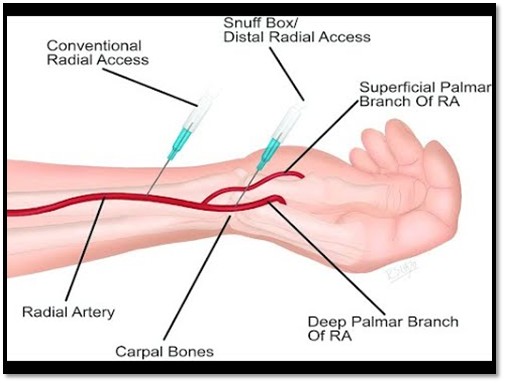
Transradial angiography uses the radial artery in the wrist instead. While the artery is smaller, modern specialized catheters have made this route incredibly efficient. Because the radial artery sits close to the surface and rests right over the bone, stopping any bleeding after the procedure is as simple as applying a small, plastic wristband.
4 Reasons Why Radial Angiography is the Superior Choice
Clinical research and patient outcomes consistently favor the radial approach. When we look at cardiovascular guidelines and metabolic health studies, the data points toward four distinct advantages:
- Drastically Reduced Bleeding Risks
Bleeding at the entry site is the most common complication of any angiography. In the femoral (groin) approach, an internal bleed can be massive before it is even detected. In contrast, the radial artery is easily accessible. If there is any issue, it is visible and easily managed. Studies have shown that the radial approach reduces major bleeding complications by over 70%, making it significantly safer, especially for patients on blood thinners.
- Immediate Mobility: “The Walk-Out” Factor
This is the biggest “win” for the patient. Unlike the femoral route, there is no requirement to lie flat for hours. Once the procedure is complete and the compression band is placed on your wrist, you can sit up immediately. You can eat, use the restroom, and—in many cases—walk out of the hospital within just a few hours.
- Enhanced Patient Comfort and Dignity
Let’s be honest: a groin-access procedure can feel invasive and awkward. The radial approach allows you to remain in a more natural position, clothed in a standard gown, with your privacy fully maintained. For seniors or those with back pain who find it impossible to lie flat for hours, the wrist-first method is a life-changer.
- Faster “Return to Life”
For the busy IT professional in Pune or the active senior in Vashi, time is the most valuable asset. Because the recovery is so fast, most patients can return to light desk work or their normal household routine the very next day. There’s no “hospital hangover.”
The Science Behind the Safety
Leading journals in cardiovascular science emphasize that the radial artery has a built-in safety net: Dual Blood Supply.
Your hand is supplied by two main arteries—the radial and the ulnar. If one is being used for a procedure, the other continues to provide full circulation to the hand. This redundancy is a biological insurance policy that doesn’t exist in the same way for the leg. Furthermore, metabolic research suggests that the lower stress levels associated with a faster, less invasive recovery contribute to better overall physiological outcomes and lower post-procedural cortisol spikes.
[Suggested Multimedia: A 3D medical illustration showing the dual blood supply of the hand (Radial and Ulnar arteries) to visualize why the procedure is so safe.]
FAQ: What You Need to Know Before Your Procedure
Q: Is every patient a candidate for Radial Angiography?
A: About 90-95% of patients are. A simple “Allen’s Test” is performed by your doctor beforehand to ensure your ulnar artery is providing enough blood flow to support the procedure. If your wrist arteries are too small or twisty, the doctor can still switch to the femoral route, but the “Wrist-First” approach is always the primary goal.
Q: Is the procedure itself more painful?
A: No. In fact, many patients find it less stressful. A small amount of local anesthesia is used to numb the wrist. You might feel a slight pressure sensation as the catheter moves, but the heart itself has no pain receptors on the inside. Most patients describe the feeling as “strange” but not painful.
Q: Does a radial check-up mean I can’t have other procedures like TAVI?
A: Not at all. Radial angiography serves as a diagnostic pathway. If your heart requires more advanced treatment—such as Transcatheter Aortic Valve Implantation (TAVI)—the radial check-up provides the necessary roadmap. In fact, the minimally invasive approach of radial angiography complements the same patient-friendly philosophy that makes TAVI such an advanced treatment option.
Why Authority and Experience Matter
While the radial approach offers several advantages, it is also technically more demanding for the cardiologist. It requires exceptional precision, refined technical expertise, and excellent tactile feedback. When choosing where to have your heart evaluated, it is important to select not just a clinic, but a center with extensive experience in the “Radial-First” approach.
In today’s rapidly evolving world of cardiovascular medicine, you deserve a team that values your comfort just as much as your clinical outcomes. Choosing experienced specialists in interventional cardiology ensures that your heart evaluation becomes a smooth part of your day rather than a major interruption to your routine.
For residents of Mumbai and the surrounding IT hubs, expert cardiac care is readily accessible. If you are looking for a team that combines advanced technical expertise with a patient-first approach, Cardium offers comprehensive care ranging from advanced diagnostics to complex structural heart interventions. Their commitment to excellence helps ensure that every patient receives the highest standard of cardiovascular care.
Don’t let concerns about a lengthy recovery prevent you from getting the answers you need. Choose the “Wrist-First” approach and return to your daily routine with greater confidence and convenience.
Schedule Your Same-Day Heart Check
Take the stress out of heart care. Connect with our specialized team today for a comprehensive evaluation that respects both your time and your health.
Dr. Rahul Gupta
Cardium Heart Care
Address: Shop No. 1 & 2, Intercity CHS, Swami Samarth Marg, behind Fire Brigade, Juhu Nagar, Sector-16, Vashi, Navi Mumbai, Maharashtra 400703
Phone no: 09869325666
Recent Posts
-
 Stem Cell Therapy 2026: Can We Actually Regenerate a Damaged Heart Muscle?
 -
 Pacemakers in 2026: Why the Latest Leadless Devices are Practically Invisible Under the Skin
 -
 The 10-Minute TMT: What Your Stress Test Result Actually Says About Your 10-Year Heart Risk
 -
 How Advanced Heart Care is Giving Pune’s Grandparents a Second Lease on Life
 -
 Stent vs. Bypass: How AI-Guided Imaging Helps Dr. Rahul Gupta Make the “Perfect” Choice for You